Collaborative Care: How evolvedMD is Tackling America’s Mental Health Crisis
July 02, 2024

In this blog you will learn:

Imagine a man named Isaac who struggles with moderate depression and diabetes.
He’s been trying to get help for months, but every time he calls a therapist, he’s told they aren’t accepting new patients. Some don’t even take his insurance, and paying out of pocket will cost more than $150 per session. His depression is taking a toll on his relationships, his once thriving business, and his diabetes.
Unfortunately, this has been the reality in the United States for years. According to Mental Health America’s 2024 report nearly 60 million Americans experienced a mental illness in the past year. Nearly half didn’t receive treatment at all. And more than half who did got it from their primary care doctor.
Primary care clearly lives up to being the “front door” to healthcare, but there are challenges. The Bowman Family Foundation’s eye-opening report shows that:
Doctors and their staff aren’t at fault; we know they’d do anything to meet their patients’ needs. They’re just simply not equipped to do it alone. And if we don’t intervene, people like Isaac will continue to suffer.
But there is hope. Healthcare leaders in primary care and mental health have united to support Isaac and millions like him. We at evolvedMD are leading the way with our unique approach to collaborative care.

Compared to traditional healthcare, collaborative care is an integrated approach that treats behavioral health conditions in the primary care setting, among others. In practice this means patients can see a mental health therapist in the comfort of their preferred primary care practice for anxiety, depression, and other conditions.
Collaborative care was first developed at the University of Washington’s AIMs center. Since then, a few leading healthcare organizations, like evolvedMD have enhanced the collaborative care model to meet patients’ physical and mental health needs. At evolvedMD, our unique approach to collaborative care places a licensed mental health therapist, called Behavioral Health Managers, onsite and in person at each primary care practice we serve. Rounding out the collaborative care team is a Care Coordinator to handle administrative tasks such as scheduling, and Psychiatric Consultants to manage and recommend medications. The patient’s primary care provider leads this collaborative care team to address the patient’s whole health.
Collaborative Care is the most effective way to increase access to affordable, high-quality mental health care for patients like Isaac. More specifically, collaborative care offers key benefits to both patients and providers alike:
The Bowman Family Foundation presents a handful of recommendations to accelerate Collaborative Care adoption nationwide. Chief among them involve partnering with private vendors that specialize in Collaborative Care.
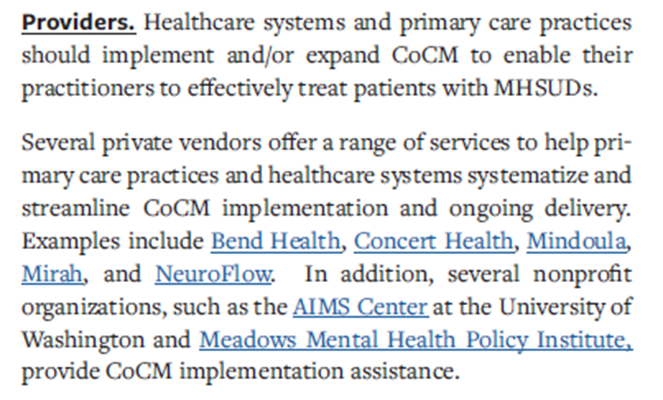
While we’re not mentioned in the above snippet, evolvedMD stands apart from its competitors for several key reasons:
In-Person
While modern healthcare increasingly relies on virtual services, research shows that over 70% of patients prefer in-person visits. Aligned with medical research, evolvedMD is the only Collaborative Care provider that strongly advocates for an in-person approach.
Embedding our licensed therapists in doctor’s offices enhances communication, improves continuity of care, and delivers comprehensive services, leading to improved patient outcomes. In fact, our approach achieves remission of depression over 10x faster than traditional care, and we’ve achieved up to 22% better clinical outcomes than industry average.
People First
Our approach thoughtfully considers not just the patients we serve but also doctors, primary care staff, and our mental health therapists, too.
Why? The American Medical Association discovered that healthcare workers had up to three times the risk of burning out. Burnout leads to chronic fatigue, job dissatisfaction, and mental health concerns. It’s not good for doctors and therapists, and therefore not good for patients.
Our approach to Collaborative Care emphasizes deep collaboration, in-house administrative support, and self-care. When frontline healthcare professionals feel supported and cared for, they deliver exceptional care and patients enjoy improved outcomes–faster. It’s a win-win.
Impactful Partnerships
One of evolvedMD’s values is “We Connect and Collaborate.” This rings true for both our team and our growing roster of partners championing Collaborative Care.
We don’t just partner with some of the nation’s largest primary care systems; we also partner with healthcare tech leaders like NeuroFlow (see in above snippet.). The market leader in technology-powered behavioral health integration, we leverage NeuroFlow’s proprietary patient registry and mobile technology to enrich collaboration, reduce clinical burden, and drive improved patient outcomes.
Advocacy
Advocacy groups, charity foundations, and the U.S. Department of Health & Human Services continue to invest significant time and money into expanding access to lifesaving services.
Unfortunately, evolvedMD’s home state of Arizona is behind. Ranking 49th in the nation according to Mental Health America, we’re experiencing higher prevalence of mental illness and lower access to treatment than ever before.
What’s worse, the Arizona Health Care Cost Containment System (AHCCCS) Administration, our state’s Medicaid agency, introduced rate reductions for Collaborative Care in October 2023. This reduction has made providing lifesaving services to Medicaid patients nearly impossible, meaning the most vulnerable will not have access to care.
So, we penned a letter to Director Carmen Heredia to reverse the decision, with more to come in our other markets – starting with Utah.
That’s why we will continue to innovate and advocate for what’s right. Our desire to disrupt has helped us serve 30,000 unique patients and increase access to care for millions more across the Southwest—with more to come. It’s what Americans deserve, and the nation’s top healthcare leaders are taking notice.
If you’re a primary care leader who wants to do right for patients like Isaac, partner with evolvedMD today.
If you are a patient seeking services, please check our website for our partners in the Southwest and if you don’t see your primary care provider listed, please send them this blog and have them call us.